
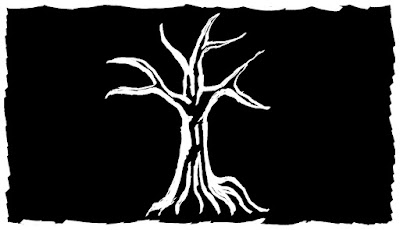
Regardless of the passing novelties of culture, falling like leaves in the autumn, there are indispensable riches that transcend even a dead civilisation or social order, to persist. The essential heirlooms of a civilisation are protected and planted again, like acorns.
The origin of the term "radical" came from the Latin word for "root". Those who were radical would hack at the root, or get to the root of the problem. They would, to use an expression favoured by Jean-Paul Marat, bring the hatchet (or ax) to their root.
Inevitable moral decay?
Far from needing to be hacked down, trees eventually die by themselves. If nothing else brings illness to the tree, its death can occur when it becomes so large that it can no longer support its own weight. Then, however majestic it may seem, it will collapse. A tree may even rot while it stands, such that its great size and apparent triumph over other trees may mean nothing.
There have been successive civilisations that were at the centre of the economic life of the world. Sumeria, Babylon, Egypt, Greece, Rome, and the more vaguely defined "Western civilisation" of the present day, with its multiple centres in London, Washington DC, Paris and elsewhere. There is no disputing that each of them collapsed, nor can we dispute that the collapse was necessary for the continued excellence of humanity, although the modern one cannot countenance its own ultimate fate as anything similar.
Many people of a conservative persuasion believe they see things rotten about our society, things that are continuously changing for the worse. They may point to increased sexual liberty and rights that were not typical of the higher and more accomplished stages of a civilisation. It has been argued that a higher civilisation adopts puritanical moral structures and a focus on scientific and artistic accomplishments in order to impress, and that denying excessive sexual liberty assists in this because it helps to keep humanity focused on human excellence rather than primitive joy. Those of a liberal persuasion, on the other hand, welcome any increase in personal liberty, and will only laugh at the above, but their response likely isn't any newer than the views of people during other declines.
It is difficult to form a rational case in relation to the idea of the moral corruption of society, because the outcome depends on one's pre-existing values. The very process of analysing flaws in the moral character of society requires first of all adopting values without rational justification, such as the view that excellence and intellect are better than laziness and pleasure.
How to detect decadence
Decadence, the steady loss of what gave a culture its value, may manifest in worsening cultural products and art forms that are not worth saving, in contrast to the creations of what would have been considered the works of a higher civilisation in its golden age. Everything is just a passing, worthless thing. This may result in a decreased ability to identify with any kind of culture and eventually, with other people in society. Even still, we may still have powerful governments, reminiscent of empires of old, dependent on the inertia of past accomplishments, up until the moment of their failure.
The idea of decadence implies that those who succumb to it either don't recognise it or don't recognise a problem with it, maybe instead being pleased with it. The concept suggests that a society can become sick without even realising it, because its own capacity to recognise goodness or judge itself is also being corrupted, succumbing to the same cultural and intellectual sickness it cannot see.
Decadence also signifies age. If it is a real sickness, it is inescapable and everyone is somewhat infected. Where the conservative is wrong might, then, not be in his dismay at the diminishing of moral or cultural value, but in his delusions that he can do anything to reverse it. A dead tree cannot be restored to a living one, and the clock cannot be turned back on society. Only a fresh acorn, planted elsewhere, has any potential after that.
To fell the tree
It is possible to appreciate both the progressive and the conservative, to see their roles in history.
The believers in progress perform a necessary role in the life of a civilisation, allowing the adoption of new ideas, new scientific models, and new technologies, but any kind of utopia may ultimately prove impossible or harmful, and so the reactionaries also have a valid role. If indeed a civilisation collapses, those who depended on its present state are not going to be the seeds of a new tree; only conservatives could create new civilisations or establish the next outposts of progress. Think what you like of them, but they bear with them a tried and tested formula for how to construct a society and civilisation, whereas the modern liberal only bears faith in the progress of the existing model and will refuse to go back to past traditions or simplicity.
The conclusion that necessarily follows from identifying what is considered decadent is that a thing is unworthy of respect or loyalty, once it is sufficiently debased that you no longer identify with it. It follows that a decadent culture or civilisation imperils those outside of it, like a rotten tree that threatens to fall when it might be inconvenient and should therefore be felled with all urgency. Its destruction, like that of Sodom and Gomorrah in the Bible, can eventually be justified.

