Showing posts with label democracy. Show all posts

Give Gaddafi’s son a chance?

Muammar Gaddafi’s son, Saif al-Islam Gaddafi, is seeking to be elected as Libya’s president. Should this man, representing what remained of his father's political movement after his violent ouster from power, be given a chance in a democratic system?

It seems unlikely that Gaddafi's son could achieve power, with his image being too linked to the violence that tore the country apart in 2011. However, some sought to block him entirely. In 2021, he was disqualified for alleged participation in war crimes during the civil war. That decision was overturned shortly thereafter, allowing him to stand once again.

For many, disqualifying Gaddafi’s son will seem like a prudent move in the interests of democracy, but that opinion in itself is contrary to democracy. In order for democracy to be genuine, you need to give people genuine choices. That necessarily includes choices you may find threatening to democracy itself.

There are valid reasons to think democracy can become a dead end for a nation. Democracy can be suspended in the name of democracy itself. Western governments embraced the suppression of the winning party in Algeria in the 1990s for this reason, triggering a devastating civil war. The US government also maintains this same attitude with regard to Hamas, which it maintained was a terrorist organisation despite it being legitimately elected.

Western regimes like to exploit the idea of democracy and the good feelings of many towards it as a facade for their own uncontested rule, because it is the system vulnerable to their interference. Western leaders discard democracy for a coup and bans targeting opponents, as soon as they are frustrated with the results, until a sufficiently malleable and vulnerable political system is back in place again.

The word “democracy” is repeated by our politicians in the West, but they regard the people as vile and deserving to be cheated rather than served.

Read More »

Bilderberg, WEF abandoning the globe for the West

Considering the agendas listed for their most recent meeting, it is noticeable that the Bilderberg forum is focusing less on the supposedly empathy-driven management of world human welfare and much more on the survival of the West. The West, meaning the narrow portion of the world whose most influential people attend these very meetings.

The new focus on ongoing conflicts like Ukraine's reveals that this group is not focused on managing the world’s economic wellbeing but the group’s own members’ desires and insecurities.

Shifting agendas away from world human welfare

If you look at the agendas from 2010 onwards, there is a certain shift from more scientific global concerns to increasingly narrow political ones, driven by a craving by the Western liberal attendees for victory and conquest over other countries and ideologies they personally disapprove of. Notice, in particular, the disappearance of the importance of climate change, formerly a key pressing issue in globalisation and a real basis for global cooperation, now abandoned by these supposedly caring leaders and experts for their preservation of their own political influence. Fear is the motive of their discussions - their own fear, not society's.

Some will begin to ask, was climate change ever real for those people? And, if it is no longer real for them, why should any of their current concerns be taken seriously outside their club? It seems that the most pressing global issues are less interesting to them than what they personally fancy or caters to their personal interests.

The same pattern is apparent at the World Economic Forum, which prioritised talking about the conflict in Ukraine, highlighting global fractures and amplifying conflict rather than maintaining the false liberal tenet of global cooperation. It is striking that the ideological principals guiding Western society just fluctuate depending on what would be satisfying to its richest and most influential individuals at the moment, getting us to scratch their itches. Globalisation and harmony one minute, national power and domination the next. Free markers one minute, state intervention the next.

'Me, me, me'

What we see here is that these forums for bigwigs, experts and public figure seem to be losing their pretence of being caring and responsible managers over global welfare, indicating this was never authentic in the first place. They are out for themselves.

What has happened can be compared with Bill Gates’ apparent obsession with conspiracy theories about himself (also see that one of the Bilderberg agendas is again "disinformation") and his need to save himself from campaigns against his character. Rather than acting like the bewildered but well-meaning philanthropist he claimed to be, and removing himself from a controversial situation, he is increasingly obsessed with defeating a political enemy, even coming into conflict with Elon Musk.

What happened to the experts who focused on the bigger picture of global society and health? Why should we care about their terror at conspiracy theorists in their own society and apparent geopolitical threats from Russia and China to their influence?

Eventually, we will begin to ask: what need do we have for a conference among individuals whose main interest is just their own avoidance of being hanged by the people? Is saving some self-important pencil necks we know very little about, from being snapped, really necessary for the public good and urgent for society to pursue?

Liberalism without prosperity?

The basic appeal of liberalism, and more so the neoliberal economic policy that dominated the world for decades, is meant to be the prosperity it optimises (or at least prevents the loss of). Unfortunately, faced with acute conflict in the world, proponents of this ideology may be increasingly instead turning to sacrifice and austerity in the name of 'civilisation', promoting a geopolitical struggle against competing poles of power like Russia and China. This puts liberalism in the position of, in the future, not presiding over a prospering people but a starved and hobbled people who wonder what it is all for.

Without offering prosperity, liberal democratic states offer nothing. By trying to convince people to enter a global confrontation with opposing continents, and forget about global welfare and even food supplies, the liberal regimes will throw away the only thing they were meant to be about. What hope is there, then, for their survival?

Read More »

Dead democracy theory

There is the 'dead internet theory' according to which most of the supposed humans on the internet are fakes, although this hypothesis probably doesn’t withstand scrutiny.

However, things that are far more important may be mostly fake. The advanced democracies in what we call the West are home to exceedingly unpopular regimes that seem to rely more on backing by pre-existing rulers, manipulative lobbies and media conglomerates than authentic popular support. As such, the democratic mandate of these regimes could be said to be false.

When a democracy gets too old

If the majority of people are against the regime, then such a regime cannot be said to be a living democracy. Perhaps a democracy being "advanced" translates to it being "aged", dying, or perhaps dead. These democracies are advanced and unflinching in their confidence not due to some sort of robustness and maturity, but because of their inflexibility and lack of any true loyalty to the people.

One can speculate that advanced democracies are long dead, having sagged outside the bounds of their original constitutions to become evil. Stepping outside of metaphor, it would mean they have existed for so long that any way of gaming the system to thwart the wishes of the people has long ago been discovered and refined to perfection by the few who have power. Every loophole is mapped by those who need to know about it, such that there are infinite ways of thwarting the people and defying their will, while maintaining the window-dressing of democracy. 

Rulers have effectively insulated themselves from the people, so that the system is effectively a lifeless and sterile corporate husk. The only “democracy” to be witnessed is futile cosmetics and the repetition of the word itself, more like an article of faith than a factual reality.

Young democracies are full of life and purpose, having recently emancipated their people. However, all old democracies, even in the ancient world, eventually perished, having lost support among anyone other than a small elite who were cheating and exploiting the system.

'Lesser evil'

Voter apathy is far worse than mere low turnout in elections, since it includes those who only grudgingly cast votes for the lesser evil, as if any living democracy would be like that. This gives rise to a reality in which nobody other than a tiny minority, heavily engaged in the political system and shaping the available candidates, believes in its legitimacy. Meanwhile, the vast majority are quietly resigned to being governed by whoever is in power or picking from a menu that features nothing they want, feeling certain that any effort they made to participate would be thwarted successfully by the pack of wolves who fought their way to the top long ago.

The result is that advanced democracies may be hostage to a hyper-vocal and aggressively involved minority, perhaps twenty percent of the people, often driven more by their deep contempt for all the other people than any respect for their will.

If the above speculation is right, then the ones who most like to pretend democracy is alive may be those who believe it serves their narrow interests. Such a group is hardly the people, who are in fact lifeless corpses kicked and beaten by that narrow group who rule. The say of those lambs is absent, they are dead, and what persists is only the hijacking of the state by predators eating them.

All of this is, of course, only an exercise in speculation, like the dead internet theory. But it helps to sometimes posit the most diabolic interpretation of the state of things, so to stimulate thought.

Read More »

Imported government rule, or unpredictable uprising?

Pakistanis may be forced to choose between accepting the imported government that was imposed by the removal of PM Imran Khan, or setting a course into destabilisation as the West’s agents and local traitors use any trick to keep control.

Some commentators such as George Galloway (tweet deleted but I linked it when it was still live, anyway) seemed to suggest there could be some sort of conflict breaking out between the people and the imported government of Shehbaz Sharif. The demand of everyone concerned is just that there should be an election soon, rather than an acute political conflict, but how likely is a peaceful and valid election to happen in a country just recently subjected to US-led regime-change? It seems more likely that protesters would have to fight, just for this modest demand to be met. The question then is, is it really worth it?

State effective at suppressing the people

One must consider that any organised aspect of mass disobedience is always suppressed quickly if the state takes serious action to stop it (this applies in any country). The people themselves are never a sufficient force for regime change (or in this case, restoration), which is only ever orchestrated successfully by people with foreign backing or substantial state-like powers, regardless of how much support they have among everyday citizens.

When people, such as Donald Trump’s supporters in the United States, believe too much in American national founding myths and consequently think that popular disaffection alone can result in regime change, they are invariably disappointed. Real regime change, or even a successful movement, is coordinated by organised actors, whether for good or evil ends.

It is clear that the Shehbaz Sharif government (likely with the blessing of the Democrat-controlled White House) is okay with treating Imran Khan supporters in a repressive way via arrests, much the way Trump's supporters were treated after the Capitol Attack.

Even the most unpopular regimes are able to maintain their grip on power, only really losing it if they cannot maintain the living standards, food supply and necessities that keep the people indebted to their power.

If it were to happen, the only likely regime change or even guarantee of prompt elections in Pakistan would have to probably come from the intervention of the Pakistani Army, who are accused anyway of playing a big role in removing Imran Khan in the first place. And a scenario of the Army or security forces mutinying, even to side with the people, is dangerous, especially considering the possible foreign involvement of the US and its ability to sponsor violence if it does not like such a change of power.

First and foremost, the top concern should be that people of Pakistan should stay safe, even if it results in a puppet regime. It is a difficult moral choice between being a subservient nation for the sake of order and safety, or a defiant nation that could risk chaos and strife.

All stability is precious

Pakistan is by no means exceptionally vulnerable or contemptible, even as a US puppet. Britain is also not its own master, compelled by what are arguably pro-American and pro-European traitors into ignoring the national will or treating it with disdain, as seen with Brexit. It seems to be in our character that we make the choice for stability rather than for confrontation on an insurmountable issue, because people are just more worried about anarchy than injustice, and we have always been this way.

What marks good people apart from the kind of psychopathic warmongers who drive US foreign policy plotters and their coups is the view that stability is a precious oasis in a chaotic world. Order is invaluable to the lives of the vast majority of people, however suffocating the status quo may be to an idealist. US warmongers and Neocons cannot hold such a view, because their distorted morals hold that mass death and misery on any scale and for any duration are justifiable to satisfy their often crazed and anarchistic political demands (which are often based on propaganda and fakes anyway). They are uniquely evil among sentient beings for this reason (the only other faction like this being ISIS, which many Neocons were apologists for in Syria). Responsible players need not be like them, and should instead opt for stability and reconciliation even when their political wishes are not quite met.

Uprisings and acute political conflicts are tolerable only if the alternative is known to be worse. If the imported government in Pakistan creates intolerable conditions for the nation because it places Western masters over the people, then the time is right that the people and state must take risks to save themselves. Until then, everything should just be subjected to a risk-benefit assessment, with any sort of dramatic regime change or restoration being understood to be a dangerous course.

Read More »

Unpopular, undemocratic leaders inspired by Macron

For Tony Blair to see hope in an unpopular centrist’s minoritarian grip on power tells us all we need to know about him and his ilk.

French president Emmanuel Macron is in power again, despite being unpopular, which hardly is a testament to the legitimacy of an advanced democracy.

Rule of the unpopular

Tony Blair evidently sees such figures as the ideal politicians of the future, which is unsurprising when we consider Blair is loathed by the British people. It is possible that finding inspiration in another minoritarian’s grip on managing a public that hates him is just a way for Tony Blair to cope with his own ruin.

Those who are participating in Tony Blair’s “Future of Britain” conference in June stand out as a veritable menagerie of snakes moved mainly by a hatred of the majority of people and an inability to identify with them, who are persistent about ruling them nonetheless. There are Labour defectors who fled their own constituents and party colleagues to the Liberal Democrats, evidently repeatedly frustrated at democratic results like Jeremy Corbyn's former Labour leadership and Brexit, and desperate to undo them.

Contempt for the people

To such people, the idea of minoritarian movements that primarily focus on their contempt for the people and placing their own snobbish authority on a pedestal is greatly appealing, which is why they turn to Emmanuel Macron for inspiration. Macron's ignorance of mass protests and ability to withstand deep unpopularity to be re-elected (mainly just by having a divided and diverse opposition) represents the ideal model regime to these people – one that can be devoid of democratic legitimacy but still use the language of democracy.

'Anti-populism' has increasingly become just a movement of misanthropes, for whom the biggest challenge of the day is their own nation's will and their need to suppress it.

Read More »

Now will Americans wake up to the foreign policy problem?

Rand Paul delaying military aid to the central government of the Ukraine, in the hope Americans can get better assurances about how their money is being spent, was unquestionably a good thing.

One thing the media is getting right is that Americans need to think more about their country’s foreign policy, and they need to think more about how it affects them. Unfortunately, the majority of opinions being presented amount to a simplistic pro-Ukraine messaging campaign, undoubtedly also sponsored by the US government.

Costs of interventionism

Previous adventurism and foreign entanglements were at very little cost to Americans, compared to the possible fallout over the Ukraine. Biden himself warned of pain when it comes to Americans affording gas, connecting it with the conflict he wants to intensify in the Ukraine.

There is ample reason to think the war in the Ukraine will be lost by the West, however long it takes. The two-decade War in Afghanistan was more likely to succeed than a war on the Russian steppes of the Ukraine, where Russia is highly invested and sufficient millions of ethnic Russians reside, enough to justify not just a temporary Russian presence but a permanent one, even with great loss of life.

No hope of Western glory

The Ukraine conflict offers no hope of Western victory and expansion, just like Afghanistan, Iraq and Syria. Revelling in Russian soldiers dying, which has been the case anyway for local Russian civilians in the Donbass since 2014, won’t change the connection of these people to a land they long possessed and have the ability to at least control a great deal of. For us to think killing Russians is the answer to the West's problem here is nothing more than a manifestation of violent urges to compensate for the Western flight from Afghanistan, and no more than a continuation of killing the Taliban, which turned out to be pointless. In the end, the land will always be possessed by the people who live and die on that land, and not by those who want to brag about how many people they killed there, which is all the US does in every conflict it loses.

Conflict with Russia exposes countries to potential famine, as Biden blamed food shortages on Russia. Western countries are not immune to this problem, and the West could be swamped with the emaciated fleeing migrants from other countries. Given that global warming can affect crop yields, we could end up facing famines in our own countries, the UK and US, if the war lasts a long time and the Russians are willing to endure it for decades.

Notice the unelected parasites of US policy

For the first time in recent history, foreign policy issues seriously affect Americans, such that their welfare may depend on identifying and removing the long-term US foreign policy strategists guiding successive administrations into failed wars. Unfortunately, there is no clear means to achieve this. The revolving door between so-called "journalism" and foreign policy advisory roles exposes that the junta of undemocratic maggots stays in control, no matter what administration replaces the last, and these maggots never leave.

Look at Antony Blinken, Victoria Nuland, Jake Sullivan and Ned Price, as a few examples of varied importance. While sharing the same murderous neoconservative glare, responsible for thousands of deaths in failed wars in the Middle East, each such person has never stood for election, instead cowering from the people and worming their way around them, and yet still shaping policy and laying out the only options available to the administration. The American people will need special tweezers or an iron fist to remove these unelected parasites, or their ideas will be responsible for creating unmanageable costs for citizens.

Read More »

Space Force expansion unmasks Biden as Trump?

Donald Trump's opponents ridiculed the US Space Force, which was originally presented as a flagship policy of his presidency and somehow indicative of the flaws of his leadership.

We were expected to believe that the Space Force somehow distinguished Trump from what would have been Clinton’s policies. However, in reality, everything would be the same, regardless of who led it and took responsibility.

Joe Biden, far from scrapping the "Trumpian" branch of the US military, kept and is expected to expand the Space Force, creating a Space National Guard, this being one of his own supposedly unique decisions. This time, the initiative for more of exactly the same thing is coming from the other party, as if the two parties are one and the same.

President poser

The same tendency to have a leader claiming responsibility for whatever the state desired anyway, is true of other moves, such as the withdrawal from Afghanistan. Had Trump ordered that withdrawal, it would have be portrayed as a uniquely “Trumpian” move by the idiots who instead made apologies for it only because Biden did it.

What we see clearly shows that presidents are just opportunists and posers for photo ops, who have no real policy ideas and just claim ownership for whatever the permanently attached limpets and advisers from the military and intelligence junta are simply doing anyway.

The unelected state

The US state places no value in the American people, and everything it does is for the expansion of its own power at the nation's expense. The corrupt intelligence services who spied on their own people, and were exposed by Edward Snowden as crooks, were driven to protect themselves from the people. The most aggressive American policies, such as propaganda and torture, are devised not to help the American people but to protect the self-serving individuals in charge from embarrassment, overthrow or prosecution. We can see this from the pursuit of Julian Assange, whose only threat was to the careers of torturers and war criminals, and he will now be handed over to them for torture.

The real leaders, who govern by expertise rather than the approval of the public, really invent American policies and oversee them over decades.

The real leaders are the statist party of “professionals” who wander in and out of government, the press and think tanks, being respected wherever they go, regardless of the results of their ideas. Hapless elected officials act as empty suits for the junta’s agenda, showing no difference from each other except the manner of their words. This reduces democracy to a puppet show for the weak-minded, as the “professionals” purposely avoid standing for election and likely don't bother even voting, yet frequently mention the word "democracy" as deception.

Read More »

Suspicions about ‘Billionaire elites’ don't make sense

One must always be cautious of simplistic claims and laymen’s theories about the source of destructive governance and the loss of collective prosperity. Such are the most common claims of agitators, but they often have no validity when assessed rationally.

The notion of an exclusive club of rich people, the billionaires, deciding our fate, is one such kind of mistaken simplistic theory. It proposes a link between people’s net worth and their attraction to Malthusian or dystopian visions of the world, which are then pursued to the detriment of the masses.

Great Reset as the work of the rich?

Internet entrepreneur Kim Dotcom (of fame for Megaupload and later the cloud service Mega) was recently tweeting about the ‘Great Reset’, positing that the ‘elite’ want to shield themselves from the shocks of a plan they have to preserve their own wealth at our expense.

The only problem with this idea is that Kim Dotcom’s own 10-million-dollar net worth is higher than Great Reset mastermind Klaus Schwab’s rumoured 1-million-dollar net worth. Such a discrepancy would appear  to throw any kind of analysis suggesting a Malthusian billionaire elite, planning mass serfdom of the people through the Great Reset, into doubt.

In addition, other perceived heroes of the masses against a Great Reset-pushing elite include Donald Trump and Elon Musk, net worth 2 billion dollars and 290 billion dollars respectively.

Such numbers are arrived at simply by searching on the internet. They are not hidden.

Billionaire power

It is striking that the people positing the sinister plans of the billionaires often rally behind individual millionaires and billionaires as their heroes, while many of their adversaries pushing such things as the Great Reset possess poultry sums of money that are expected simply of random politicians and economists.

What is happening is that many people are convinced that power is just a direct extension of money. They succumb to the simplistic assumption that whoever has the gold makes the rules. However, it is better to say that whoever has the power makes the rules, and power derives often from knowledge rather than wealth. Furthermore, those who have power gain wealth, whereas those with pre-existing wealth often just lose it.

There is indeed an elite responsible for policy in Western countries, which looks upon the masses with scorn and condescension, but any assertion that they are a group of super-rich property owners or royals misses the real point.

Whatever the threat to the welfare of the public from the halls of power may be, it is not necessarily the work of the rich, and not even the malign doings of the royal family of Saudi Arabia or the United Kingdom. Many agitators simply point to those with more wealth or property than us as a way of getting an emotional response from their audience, based on envy.

In reality, a rich person or celebrity is just as likely to sense something wrong with the world as a poor person, and be just as powerless to act. On the other hand, a poor person may indeed have the knowledge from which to derive power, and so be able to act.

Then who are the 'elite'?

Meritocrats.

Our politics and our perceptions are shaped not by a moneyed elite, but rather by a self-appointed ‘power elite’ that consists of people who merely curried favour enough to pass through the revolving doors of think tanks, mainstream media and the government, allowing them to create ideas (think tanks), manufacture consent for them (media), and implement them (government). At no point in this process does this powered elite have any empathy with the public, merely viewing them as a hurdle to the implementation of their own vision. Such individuals will repeatedly hold offices to which they are appointed and that do not require a democratic election (National Security Adviser in the United States, for example). While no single such post is necessarily powerful, together these unelected posts allow a narrow group of people cut from the same statist ideological cloth to continuously guide the nation state on a course opposite to the wishes of the people, regardless of electoral outcomes. It is this meritocratic group spanning think tanks, government agencies, and media conglomerates, that all think alike in their will to subvert democracy, to compel the regime against the wishes of the people.

One thing to bear in mind is that what is being described here is not a flaw of any kind of system that can ever be corrected by the law, nor is the diminishing of democracy by the hands of meritocrats necessarily a bad thing. It may well be that this professional governing corps really does produce the best outcomes for a nation, whereas the people are foolish. The meritocrats are simply an element that can be either ripe or rotten within any organisation, and there is a good case that this element has become fully rotten in Western democracies, having become obsessed only with its own security, fearing the nation as a hostile mob to be monitored and suppressed.

The elite are not especially rich, but merely favoured. Many of them could be nice people, in the manner of a prince, but amenable only to those they know or meet, and that is an exceedingly narrow group. This persistence of the same narrow group of meritocrats for too long can become inimical to any authentic idea of democracy or republic, which are reduced to lies.

Read More »

Irish unity would be fair, but also destabilising

Sinn Féin is set to be the largest party in the Northern Ireland Assembly, after the results in local elections that took place in the United Kingdom on May 5.

What has happened pushes the UK towards a perhaps inevitable breakup, as Sinn Féin has long sought a united island of Ireland, which would be noble if they can secure majority support in Northern Ireland for it.

A return to Great Britain?

The people of Britain actually have no need for Ireland. If we were to lose Northern Ireland, the imposing name of the “Kingdom of Great Britain” (or just Great Britain) could be restored as the official one, as could the flag of 1707-1801, which British troops carried to war against America and France. Such days were hardly those of a lesser power, as we are now.

Even if things went a step further, and Scotland was also to gain independence, England would likely remain a powerhouse, keeping the neighbouring countries in its influence, unless the European Union was to actively work against such sway

Unionist backlash

The only peril may come from unionists in Northern Ireland, and their ties to that land, in the event that they refuse to accept the breakup of the country they were loyal to. Political radicals and aggrieved parties often end up punching above their weight, and it is not atypical that they can take a whole country hostage with their politics.

As well as a surge in violence taking place within a united Ireland, possibly drawing in outside forces such as the European Union, there is a greater risk of political radicals fleeing Northern Ireland to assume huge influence within the newly diminished Great Britain. Should anything atrocious befall the unionists residing in the united Ireland, or even a murmur of it, it would result in radical transformations of opinion in Great Britain, creating increasingly hostile English feelings towards Ireland and its EU backers. As well as undermining Scottish independence (assuming Irish unity occurs first), a wave of unionism finding a home in Great Britain could also be big enough to turn policy in London in an aggressive or revanchist direction. If Scotland in turn got independence, further flight of radical British nationalists into England could make them even more concentrated and capable of influencing London.

The return of England

In the most extreme course of future events, breakup could result in an English war not just with Scotland and Ireland but, by proxy, with old enemies like France, Spain and Germany via the European Union as the Scots and Irish will warm to them rather than the ostracised England.

The war on Russia's periphery in Ukraine exposes new vulnerabilities for all nuclear-armed powers, revealing that they are not as invulnerable as they had assumed and that the victors of the Second World War have no guarantee of security. Having a nuclear deterrent doesn't prevent conflict being actively inflamed by outside competitors on your doorstep, or result in the adjacent non-nuclear power standing down if you use force. The informal understanding that nuclear powers cannot incite a proxy to directly attack each other's territory and infrastructure is also gone, now. Now, everyone will be just expected to refrain from using nuclear weapons, as long as sneaky enough methods are being used to kill us and there is not a direct clash. This change may cause huge displeasure to Britain in the future, since it creates new rules that put the country in a new state of vulnerability. It allows the peril of a return to past ages, when Scotland was eligible as a French proxy against England.

Restored medieval conflicts

The idea of an English-EU clash reigniting Medieval-era tensions may seem farfetched, but it is not. Medieval leaders were not less civilised or educated in statehood than modern leaders. Some conflicts are inevitable, just because of the configuration of pieces on the board.

England has a much vaster population than Scotland or Ireland. It is not too hard to predict, if the UK breaks up, that these countries will be afraid and possibly even hateful of the economically and militarily giant England after being estranged from it. The temptation to bring in France or other European powers as protectors, and English resentment at this course of events, would be almost inevitable.

Nationalism, however benign at first, can unleash unpredictable and long-buried forces, as it did after the collapse of the Soviet Union. It can create opportunities for outside interference that will jeopardise a country’s security.

When an arrangement works peacefully, like the Union, it is best to treasure it and not to change it, even if we would personally prefer things to be different. This is the same case with the monarchy.

Read More »

Let Solomon Islands choose its alliances freely

Hysterical responses to the Solomon Islands signing a security agreement with China reveal hypocrisy over the Ukraine crisis of 2014 and subsequent conflict of 2022.

NATO’s Secretary General stated that the defining struggle in the world has become one of big powers forcing smaller powers to serve their interests, or letting them choose their own path, arguing that the Western alliance group is firmly in favour of free choice.

The argument was clear: Russia was behaving very irregularly and violating national sovereignty, by expecting to have any say on hostile troop deployments into countries adjacent to it.

Nothing At All Treaty Organisation

Unfortunately for NATO, such firm principles for which the world's most powerful military alliance stood were inadvertently denounced and shown to be utter nonsense by NATO countries. As soon as the Solomon Islands chose to align with China on its own free will, the US issued warnings of unspecified consequences. Therefore, it became suddenly unacceptable for nations to align in any way against others.

The hypocrisy on display now proves that the attempt of NATO governments to stand and fight for any set of principles at all could not last much more than a couple of months. This powerful alliance is proved to not stand for anything, much as the US’s own ideology is confused and America immediately steps on its own commitments like rakes, as soon as it tries to lay them down.

Menaces to democracy

The Solomon Islands may have chosen to side with China entirely of its own free will. Ukraine, in contrast, only sought alignment with NATO and the EU after extensive interference in its internal affairs and a violent takeover supervised by Western officials in 2014.

The Solomon Islands is now to be portrayed as some sort of threat to democracy, merely by the fact it is inconvenient to the West (i.e. "democracy"). In reality, the country is a democracy threatened by coercive Western powers that clearly have no interest in the wishes of the people.

One would be wise to expect fake mass protests sponsored and led from US diplomatic buildings in the Solomon Islands, covered by all the cable news channels and praised by them. In addition, expect any scale of bribery and attempts to subvert the wishes of the people of that land, perhaps in the months or even weeks to come.

Read More »

Frenchness, faith and the presidential election

The second round of the French presidential election is due on 24 April, and the imperilled identity of the country is the one indisputable thing that a majority of French seem to agree on.

Both rival candidates, Emmanuel Macron and Marine Le Pen, are controversial, especially when it comes to their relations with French Muslims. Who is perhaps worse is not entirely clear.

Two demagogues?

Marine Le Pen compared Muslims praying in the streets, with the German occupation of the country. Emmanuel Macron stigmatises Muslims and cracks down on those who raise their voices in opposition to this. In addition, who can forget his steadfast defence of offensive drawings of the Islamic Prophet Mohammed?

Worst of all for French Muslims could be Macron's goal to rewrite Islam to be more liberal and appropriate to his vision of France. He also made an effort to close the French Council of the Muslim Faith, dissatisfied with it and with any perceived foreign influence, including simply the international communion that exists between believers across the world.

Unfortunately, France should simply be considered hostile to Islam. Between the two presidential candidates, Macron might be the more insidious, trying to actively distort Islam and interfere in the freedom of conscience.

Le Pen, despite probably having a more negative reputation with Muslims (similar to Trump), is just old-fashioned rather than insidious. She would not likely try to interfere in and pervert other people's faith, even if her policies would be more directly confrontational with France’s Muslim community, with such absurd measures as fines for wearing headscarves. It is also noticeable that Macron is a zealous Israel-supporter, going as far as to label Israel critics as enemies of the Republic, a bizarre attack that strikes directly at the consciences of Muslims more than Le Pen has done.

Civilisation anxiety justified?

Regardless of the outcome of the presidential election, France will struggle to reconcile the consequences of its imperialism and its attempts to maintain a culturally uniform nation-state. This could eventually result in separatism and violence in decades to come.

France’s differences from Britain are that Britain is not a secular state, and Britain accepted its overseas people as distinct cultures, with little interest in assimilation, as there is no Britishness to assimilate into (all aspects of our identity, from food to flags and even the Union itself, are the cumulative imperial booty acquired by Norman conquerors, so there is no core Britishness to be anxious about, like the core Frenchness).

Read More »

On Imran Khan's fight against international evil

The much-loved (now former) Prime Minister of Pakistan Imran Khan maintains a demand for a snap election in his country.

The case that had been made against Mr Khan's PTI-led government focused on the idea that he was not delivering economically, and that his popularity was in decline. It was a case amplified by the international media, primarily from the United States, to the benefit of the then-opposition.

Why not put Imran Khan to the test?

Regardless of how the United States and its local toadies may feel about Mr Khan, large-scale rallies on the ground tell a starkly different story than theirs. These rallies indicate more than nationwide discontent at the no-confidence vote that removed him, they suggest a real national awakening and peaceful national liberation struggle against the country's foreign shackles.

Strangely, smaller rallies are often cited by the United States as a reason for immediate regime change. The difference, of course, is that in other cases, the United States was likely supporting fake demonstrations or violent riots by its local mercenaries and clients, having no real interest in the democratic will of any nation.

The fear of the new regime towards the people is on display. In the first place, Imran Khan's opponents and the Supreme Court torpedoed the possibility of taking any grievances about the PTI's governance to the people with an election. A no-confidence vote to remove him was preferred, and the idea of an election was resented, because the ones responsible seem to avoid the will of the people.

Conspiracy or compromise?

While the military denies that the US conspired to remove Imran Khan by encouraging the no confidence vote, no denial has been made that the US was calling for the no confidence vote or that the whole thing was their idea. One can argue about the semantics of such things as treason and conspiracies, but if the US declared the need for the no confidence vote, then the individuals in Parliament who complied are impossible to view favourably, and it is perhaps more alarming that the military would make excuses for them.

The urgently needed general election, even if the new regime agrees to hold it, can be expected to take a long time. The Pakistan Electoral Commission (ECP) had already suggested an extensive delay of months, even when Mr Khan was still PM. It is possible that the bodies of the state not only abandoned Imran Khan but also, for whatever reason, are determined to be deaf to the wishes of the people.

The US desired policy shifts in Islamabad to help it break the international isolation faced by the Western alliance group from the rest of the world in its efforts to condemn Russia and China. There is reason to believe that such policy shifts (likely a complete departure from alliances with China in favour of the US) will not be achieved, even with Imran Khan gone, as these would likely be too economically costly to the country.

Evil by weakness

We should consider the self-serving and poor moral character of the new regime. The new PM, Shehbaz Sharif, already issued a diplomatic passport to his brother Nawaz Sharif, who had been the subject of corruption probes. So now you have a regime that, while unmoved by the people or any need to gain legitimacy with them, is moved at once to save a corrupt individual as its first act.

Despite all of the above, it still seems possible that to assert that the new regime is fully loyal to the United States would be an exaggeration. Nevertheless, the leadership this regime represents is now one that is more susceptible to manipulation and corruption. It is compromised.

It may be unfair to call the new PM evil, but what is happening in Pakistan is a clear and obvious struggle between good and evil. It is, more scientifically, a conflict between the ones standing for independence, prosperity and defiance, and the opponents who succumb to weakness, corruption and subservience too easily.

Refusal to be slaves

Imran Khan may be out as Prime Minister, but Pakistanis will grow increasingly aware of foreign interference and the foreign role in manifestations of corruption and treachery. It is likely that increasing numbers will want something to be done, and will at least wonder how different things might be if the country rid itself of all foreign-inspired intrigue.

The darkest talk surrounds the suspicion that there may be a threat to Imran Khan's life or to the wellbeing of his supporters, as the US tries to suppress a nation that defied them. However, this would be playing with fire. Regardless of what the new regime wants to be, the Pakistani people won't be slaves, at least knowingly.

People should watch, with great suspicion, attempts to contrive some character assassination or criminal case against Imran Khan in an effort to reduce his popular support, with the collusion of the international media. Rather than actual assassination, this seems more likely. It will be undertaken if the people grow quiet, refusing to counterpunch but allowing the corrupt elite and the collaborators of international evil to make their next move.

Read More »

In Budapest or Islamabad, let democracy be

The behaviour of those who propose undemocratic measures against elected leaders, while portraying them as somehow undermining democracy, is remarkable.

When the EU and Europhile journalists speak of democracy, they seem to really only be talking of the dictatorship of their important selves and their opinions as they interfere around the world. They hate the rule of the people's will, which is meant to be the meaning of democracy. The same bewildering lack of appreciation for popular rule exists among Americans who continue to chant the word "democracy" as the alleged basis of their foreign policy.

Love of fake democracy

From the point of view of democratically dubious or outright unelected elites the world over, "democracy" seems to be the favoured word when engaging in empty rhetoric. They insinuate that this word refers to their esoteric authority or superiority, rather than submission to the wisdom of the people.

The rule of the people, in fact, is equated by these corrupt beings with demagoguery and described by them as "populism". That is a favoured word among the narrow few who are frustrated when they find, to their dismay, that the people have resisted them and attempted to survive.

Hatred of "populists"

Establishment scribblers, unthink tanks and other self-appointed guardians of democratic civilisation command the international news media, as well as the constructed currents of social media. They are infuriated by the popularity of Vucic, Orban and Le Pen, although in each case the candidates are popular because they genuinely represent the views of the people. The European Parliament could not even refrain from punishing Poland, despite the adjacent Ukraine war.

The same people were also distressed at Pakistan's (now ex-) Prime Minister Imran Khan's independent foreign policy, encouraging every measure except an election to safeguard "democracy". There, we find that "democracy" used as the secret word for the deeds of unelected, bought people and schemers, rather than a genuine demonstration of popularity such as an election.

Without Mr Khan, the leadership of Pakistan is expected to be handed over to a man who said "beggars can't be choosers", in English, in response to a question about his country's foreign policy. Military chiefs in the country also broke with the elected government to say they were believers in strong ties to the United States. In contrast to that beggar, Mr Khan apparently earned hatred from the US and its allies for saying his country will not be slaves.

Undemocratic worms sighted

Skyrocketing prices and what might be approaching food shortages on the European continent are tolerated by those who are evidently motivated by something other than the wellbeing of their constituents. They believe that their challenge is not to derive their legitimacy from the population, but to chastise the population and tell them to bear the costs of their policies.

If democracy is real, the right of the people to throw out worms from society and the political system is paramount. It is essential that when undemocratic worms utter the word "democracy", it is considered a blasphemy against the people and their interests.

Read More »

When is it okay to back "rebels" in another country?

Keeping in mind the events in Libya and Syria, is there ever a time when it is okay to back an uprising by armed rebels, including by giving them weapons?

The best answer is simply, no. If one were to disagree and take the view that, as a matter of principle, rebels should be supported against repressive regimes, it will require untenable and foolish strategies all over the world. Moreover, it will often fail, like it did in Syria even after so many years.

Legitimacy

Where it may be wise to support non-government armed groups is where the case can be sufficiently made that they are the legitimate authority, as in, the state or some other legal authority, and where some formal ties can be established. In such a case, one is not really supporting rebels at all but supporting governments, and simply disagreeing about those governments. The international community and the UN are often obstinately wrong in this respect, often continuing to recognise dead regimes just because they did not like how it happened.

A decent principle to follow is that of popular sovereignty, whereby the will of the people decides whether there stands one state or another state. Referendums are excellent means to establish the validity of such sovereignty.

Different regions of the world have somewhat differing models of authority and, as such, the groups one supports in the course of supporting legitimate authorities may look "rebel"-like to outside observers. However, a group that advertises itself as a rebellion but has no clear idea about governing and can give no guarantees is usually not worth establishing relations with.

Honourable rebellion

The best rule would be that one's country may support non-state elements in a country where these elements conduct themselves in an honourable and state-like way, and where a referendum or other democratic exercise has actually established popular sovereignty. This is in stark contrast to simply producing "error"-ridden media reports asserting that the people want some kind of uprising, as is so typical of the Western press when reporting on countries like Cuba, Venezuela and Syria, only to later be corrected or redacted after the damage is done.

Another good rule is to be a sincere contributor to local and regional security in a conflict zone based on clear treaties from day one, rather than suddenly barging in on moral pretexts, as was the case with many interventions. It should always be a local power that takes the lead on how to intervene in a conflict, not a foreign superpower. Any foreign power that interferes against the wishes of the region is insincere, and little better than an invader.

Although intervention and support of rebels has often been done in a reckless and self-serving way, the practice should not be ruled out in its entirety. Where it is aligned with popular sovereignty and the will of nations to independence, it is justifiable. Support for the changing of national borders should not be ruled out, either, but only at the initiative of the local people and as a means of remedying past colonial errors.

Read More »

Democraticness, not democracy, is what matters

The word "democracy" has particular appeal to people. After all, it means the rule by the people. But it also has a dull meaning: the mere ritual of elections, in what could still be an unrepresentative and despicable regime with no legitimacy.

Leaders of Western "democracies" often have embarrassingly low approval ratings and perpetual dissatisfaction exists in society, and they rely on looking tough on alleged threats, to gain a meagre rise in popularity, rather than actually doing anything for their people. Those leaders, such as Justin Trudeau, are condescending to many of the people, which is hardly what you would expect in a system of rule by the people, the very intended meaning of democracy.

Something being "democratic" doesn't necessarily mean the introduction of the system we call "democracy" - the practice of elections, together with the money-drenched marketing campaigns and deceptions that influence the plutocratic result.

Popular rule by other means

Countries may deem themselves democratic based on other aspects of how their state works, such that they manage to embody the will of a sovereign people. This is why countries like the People's Republic of China (PRC) and the Democratic People's Republic of Korea (DPRK) refer to themselves as democratic although they do not hold televised debates or nationwide elections. The Joint Statement of the Russian Federation and the People’s Republic of China on the International Relations Entering a New Era and the Global Sustainable Development pledged Russian and Chinese support for local, authentic expressions of democracy around the world rather than the foreign-imposed and inauthentic systems that are called "democracies" by the dull.

There is something to be said for examining the democraticness, or lack thereof, in a regime's behaviour, rather than agreeing with the simplistic classification of different constitutions as a democracy or dictatorship. In the case of many Western governments and leading institutions, we indeed come up short when it comes to democraticness, despite the continuous use of the word "democracy", often by those who aren't elected.

The thwarting of the people

Across the US, the UK and the EU, for example, populism evokes horror among leaders, despite it really meaning that one is deferring to popular concerns, which is an essential aspect of being actually democratic. Populism is presented as a threat to "democracy", which only raises the question of what "democracy" they refer to, if it is incompatible with being popular.

Leaders of self-proclaimed liberal democracies such as the United States cringe at the idea of their populations actually getting anything they want, and are delighted at the idea of thwarting the wishes of the majority. The entire practice of elections, for them, is a game according to which they trick the people and manage to force upon them whatever they didn't want.

Disdain for the people

Not a word is ever uttered by the leaders of these countries about the wisdom or merits of the people, although leaders continuously use the word "democracy" with forked tongues. In fact, they deplore vast numbers of the people and make it their job to lecture and convert the people to their cause rather than represent them.

Does a sincere advocate of democracy - the system of rule by the people - have nothing nice to say about the wisdom of people, conceal facts from them, view them all as fools easily duped by intelligence services, and only offer to rule and protect them rather than obey them?

A country that actually valued the will of the people might actively labour to make all the people wiser, and then defer to the wishes of those people, treating them like an oracle. What happens instead is that the people are pressured to agree with the authorities, rather than vice versa. So, on top of the mountain of garbage that is a so-called "democracy", rests some small crumb representing how much that regime actually cares about what the people think and how much it actually shares their pain.

Read More »

"Democratic peace theory" died a long time ago

"Democracy" is meant to refer to a political system that derives legitimacy from the people, but the word usually gets used when talking of foreign conflicts. Those who talk of it will say the Western countries have a unique ethnicity, which makes them better than others.

Despite Ukraine's government banning all opposition, we are being told that Ukraine is a bastion in the fight for "democracy". As usual, Western countries teaming up to fight someone is usually the main reason to talk of "democracy", even if this is not applicable to the situation all. Someone looking for images of "democracy" won't find it hard to stumble upon scenes of explosions and dead bodies.

In the end, those who meet adoring crowds or talk of any need to serve the people are more likely to be labelled as dictators than democrats. The anonymous members of the American military and intelligence junta are presented as the men of democracy, regardless of whether they are elected or have anything to do with any democratic process at all.

Zones of freedom

The word "freedom" was used in artful equivocation by politicians such as George W. Bush during his invasion of Iraq in 2003. The conquered "zone of freedom" in fact meant an area free to be plundered and preyed on by American corporations, in keeping with the vaunted "free market" so loved by Americans. To the average listener, though, it may have suggested that the country would be freed from torture and oppression, when in fact the United States brought both to the Iraqi people. The term "zone of freedom" was also used for NATO expansion, which precipitated the current conflict in Ukraine.

The "democratic peace" theory died in Iraq in 2003, too, although its well-wishers continued to refuse to write its obituary and are now busy with Ukraine. When democracies were the ones attacking the others, and they were doing so for the very reason of their arrogant belief in their political system, it was clear that associating the democratic system with the establishment of peace was a mistake.

Democracy as a call to violence

"Democracy" is invoked almost always for the express purpose of rallying people to war, not peace. It is used to conjure up images of soldiers storming the beaches of Normandy, which, however heroic, is no image of peace. Those who plead for bringing what they call "democracy" to other lands are the most depraved warmongers of our time, even if they can successfully point to the atrocities of others.

The next time you hear a speech about "democracy", try to locate anything in the speech that offers any substantive commentary on the merits of a system of government by the people. Try to listen out for praise of the people and their wisdom, since they are meant to be the masters in the democratic system. You can almost certainly guarantee that such content will be absent, yet the word "democracy" shall keep appearing, because "democracy" is here being used only in the manner of a stupid idol with no useful properties. It is a mere word, brought forth to persuade and bring comfort to people who like to hear it.

Our countries in the West use "democracy" as false rhetoric. In practice, our governments subvert truly democratic causes and demands in favour of monopolistic power and deception. The "democratic peace" we seek is consequently false, and will never be realised. The West attacks the regimes it dislikes. Its so-called theory confuses a cloud of locusts with a rainbow of peace.

Read More »

Is war a smokescreen for Ukraine's democratic failure?

It would be a "strategic mistake", as UK Foreign Secretary Liz Truss put it, for Russia to attempt to conquer Ukraine entirely.

However, expectations about Russia seizing all of Ukraine and depriving the country of independence seem to be only idle speculation based on the mere presence of many Russian troops near Ukraine. Britain and America have not seen any plans about a Russian attack.

For all we know, Russia intends to maintain such troops permanently for as long as there is still a potentially dangerous conflict in the adjacent Donbass region in Ukraine. The Russian troop presence near Ukraine is no more evidence of a Russian invasion now than in spring last year, when we received the same warnings. We have been through this before.

Preserving Ukrainian democracy

What seems new, though, is the scandalous political situation in Ukraine, in part created by Western blunders. US foreign policy figures such as Professor Michael McFaul assert that Ukrainian democracy is Russia's biggest fear. This seems unlikely, when considering the oligarch-ridden and corrupt state of Ukrainian politics.

Ukraine could even be plunging into an undemocratic abyss as President Volodymyr Zelensky seeks to arrest political opponents and the US helps demonise them. Two top opponents Zelensky has sought to imprison are Petro Poroshenko, Ukraine's president following the ouster of the pro-Russian Viktor Yanukovych, and Viktor Medvedchuk, who is considered the pro-Russian favourite in the Ukrainian opposition at present. Between them, these two figures and their parties represent many of the opposition seats in Ukraine's parliament. If the US cared about democracy in Ukraine, it would ask Zelensky to cut them some slack as the EU did.

Popular opposition media have faced total bans as well, on the same grounds of alleged treasonous activity. However, any opposition activity or different foreign policy views could be construed as treasonous to the incumbent government, making democracy nearly impossible. Rather than noticing this worrying trend, the United States encourages it.

Falsely labelling Ukrainian politicians as Russian agents

Medvedchuk's preference for good relations with Russia in no way invalidates his right to compete for democratic votes in Ukraine. Don't expect the Americans to see it that way, though. Don't expect them to think external American interference in the Ukrainian parliament is any obstacle to democracy, either. 

Both the US and the UK seem to have started announcing Ukrainian opposition figures are Russian agents, and it is clearly false information, endangering their ability to work and even threatening their lives. This suggests the Western countries in question are insincere about bringing democracy to Ukraine and are only looking for expansion of Western power and alliances.

Consider also that any allegations about Russia illegitimately using politics to interfere in Ukraine behind the scenes are obviously hypocritical. To unearth these interferences would require the Americans or British themselves snooping around, interfering in Ukrainian democracy and picking favourites. Is our interference somehow inherently more democratic than others, even when not based on any vote or pertaining to any attempt to assess the democratic will?

Closer to the West doesn't necessarily mean democracy

Arrests of opposition, bans on media and labelling of opposition figures as Russian assets may bolster the Western hold over the Ukrainian government and bring it closer to the NATO orbit, but we should not confuse this with advancing democracy. It literally means denigrating the country's opposition and backing a regime that wants to maintain power.

We may be looking at an example of Western countries acting with no principles and simply waving around the word "democracy". The word is used as if it doesn't point to political practice. Instead, it is presented as an elusive justification for other practices, including tyranny.

The lost wars in Iraq and Afghanistan, both of which involved the US and UK implanting deeply unpopular regimes in the name of "democracy", without realising these regimes had no legitimacy, should be a warning about what could happen in Ukraine if the current policy is maintained.

Read More »

Great Reset is not a coup or even any cause for alarm

The "Great Reset", espoused by the World Economic Forum, is derided by many for being the idea of an elite who are responsible for the world's problems in the first place. But is that really a historical irregularity that deserves condemnation?

Such things as the Peace of Westphalia and the so-called Washington Consensus shape the political and economic models we know and accept. Both are the works of ultra-elite individuals, representing the microscopic affluent minority among us. Everyone accepted such things and went on, believing it was for the best.

When the super elite try to do the same now, they are met with significant opposition and, dare I say, conspiracy theories from many people who see it as some kind of coup. It is seen by some as uniquely diabolic, a usurpation of all authority over our future, removing our control of our destiny.

In reality, for all its problems, the Great Reset is no coup. Those who came up with it were already in charge of most economic policies, including those things they want to change. This kind of elite-driven reform is a continuation of what we have always known since at least the end of the Medieval era and the formation of modern states.

Great Reset threatens democracy?

Absurd. To condemn the Great Reset as a usurpation of democracy, while favouring the existing economic consensus as somehow more acceptable, is ill-informed. The current economic consensus was also arbitrarily set up by a small elite, and is demonstrably harmful to society and the environment.

The existence of nation-states at all was the arbitrary decision of a small elite in 1648, in what is now Germany. The very things supported by the masses are simply constructed by small elites, and the masses acquiesced.

The argument that the Great Reset is a usurpation of democracy seems to have come out of nowhere. Nothing is being cited to support it. The Great Reset seems to be more about altering the economic model and has nothing to do with the political system or appointment of national leaders, or even means of pressuring the states at all. It calls for no change of constitution in any nation, and no realignment of the world's nations with any cause. If anything, it seems to be trying to pressure corporations into agreeing with environmental agendas already declared by all states such as cutting carbon emissions to prevent the catastrophic rise in temperatures that may cause mass extinction.

Because the Great Reset does not posit any alternative to democracy or say democracy is a problem, it is not a threat to it. If anything, it seems to propose tampering with and rewriting the motivations of the corporations so that they really share the state's concerns about protecting the public and environment instead of posting adverts in which they pretend to care.

Claiming corporate overlords will take the place of politicians in the Great Reset seems like a stretch, as there is no literature or evidence whatsoever that this is suggested. The claim seems to be an equivocation fallacy, conflating economic management with political and going on to suggest the latter is imperilled.

Great reset threatens the free market?

Possibly. An argument can be made that the Great Reset is a threat to free markets, because it proposes altering the motivations of the corporations so that they are less driven by profit and more driven by doing good for society and the environment.

It is likely that those most alarmed with the Great Reset are the executives of companies short of those that are sufficiently large to be considered "stakeholders" under "stakeholder capitalism". They want their companies to grow, and that means at least a bit of waste and pollution in the process. They don't want economic growth to be frozen by governments and stakeholders, and social and environmental responsibility added as metrics of company success rather than just profit.

You'll own nothing

No, this does not mean your handbag or pencil case will be taken off you, or that your clothes will be rented each week and forcibly removed from you if you run out of money. It also does not mean people will have to pay for air.

The way this phrase has been misunderstood shows how much people read into phrases and start talking about them before looking up what was actually meant. Sometimes, writers use hyperbole. In this case, the Great Reset meant to advocate against waste.

A form of this would be what already happens in British supermarkets. Cheap, light plastic bags used to be given to shoppers and they would invariably end up thrown away, usually ending up next to railway lines for some reason I couldn't fathom. They are probably still there.

In 2015, the British government made companies add a charge for plastic bags. There was then a shift towards better quality bags - bags for life - that were meant to be reused by shoppers. When it eventually broke, you would hand this back at the shop and be given a fresh one for free, while the broken one is recycled.

The owning of nothing isn't necessarily all-encompassing or meant to suggest measures to confiscate things off people, as is being implied by critics. It is more an alteration of the meaning of ownership, so that things are more readily and easily recycled, reused or reallocated to somebody else when you are done, to cut back on waste.

The idea that we own anything in the first place under the nation-state model is actually something that can be seriously questioned. In a sense, we already own nothing. When you claim to own anything, you are really just borrowing it from the government or other highest authority in the land and pleading for them to act as if you own it for a while. In the UK, if you die and have no next of kin or any known relatives, the Crown inherits your property, as the Crown is a kind of supreme owner and final arbiter of who owns anything. Everything is de facto government property and territory. Already, ownership of anything is merely a temporary right, granted out of the government's generosity or some paperwork it is obliged to respect, and not because of you.

Homes and cars may be passed around with a different model of ownership that reduces the waste of resources. If electrical cars in future are all rented, or are simply part of an AI-driven public transport grid that has done away with all vehicle ownership, there is no reason to complain. You don't own a road or railway, nor do you influence the traffic control systems that keep you alive on the road. The sense of freedom and agency while driving is an illusion.

Building back better

The adoption of the Great Reset's "build back better" as a campaign slogan in the US and Canada is enough to refute the idea that a corporate coup is taking place in Western countries under the Great Reset. Politicians are actually campaigning for this, showing that they are seeking a democratic mandate.

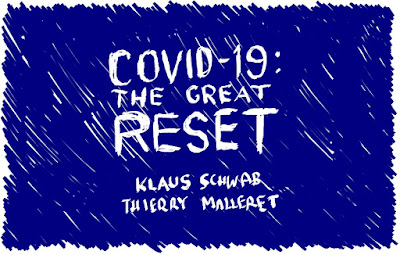
In addition, the publication of documents like Klaus Schwab's The Great Reset (2020) is also a refutation of the idea of a cabal secretly taking over. This stuff is publicly advertised, and its virtues are being extolled by these people.

The desire for a Great Reset of capitalism is the result of a planet and society tired of waste, pollution and the externalisation of costs by greedy companies. It is possible that hitherto dominant corporate overlords are offering terms of surrender to the public and trying to save their own necks by advocating the Great Reset, much as France's Louis XVI was compelled to accept the Rights of Man.

Come up with alternatives if you don't like it

The world left had the seemingly now-dead World Social Forum as an alternative to the World Economic Forum. Being the origin of the phrase "a new world is possible", it at least tried to offer alternatives to neoliberal economics. Opponents of neoliberalism continuously suffered from an inability to propose a viable alternative, instead just ending up complaining about the status quo while voters in the biggest Western economies refused to risk voting for their candidates such as Jeremy Corbyn. Attempts to implement alternatives in some countries like Venezuela resulted in economic chaos.

Rejection of the economic system can only provide a sufficient basis to govern a country, if faced with the utter failure and collapse of the existing system to the point of famine. This is what happened in both the French and Russian revolutions, in which mere critiques of the old system led to the rise of the new economic models of bourgeois capitalism and Soviet socialism respectively. The advice from these revolutionaries would be: to overthrow the Great Reset, first let it fail.

Whatever the case, netizens and conspiracy theorists will get it all wrong and succumb to abject confusion because they didn't simply visit the WEF website or read the primary sources before reading opinions about them. An idea might be to get Klaus Schwab's book and criticise it from a fresh perspective, rather than hastily siding with other people's opinions.

Read More »

Barbados should have held a referendum on the monarchy

Barbados has ditched the Queen as head of state based on a parliamentary vote, but this change likely does not reflect the wishes of the population.

According to a report, the reason Barbados did not hold a referendum on the issue of head of state is because the population would have rejected the change. The parliament sidestepped asking the population, knowing the population would vote against them.

There was good reason to think the people of Barbados would not accept removing the Queen as head of state. When the question was posed to Australia, Tuvalu and St. Vincent and the Grenadines, these countries all voted by a majority to retain their current system.

Sometimes, specific parts of a territory even want to stay under the colonial vestiges and it is right to let them stay as long as the populations still wish. This is the case with British Overseas Territories and French overseas departments such as Mayotte, which dissented from the Comoros when it gained independence and remained French.

Barbados as an unnecessary republic

If you compare Barbados with the way countries became healthy republics, there is a difference. Republics became republics as a founding act in their country's history and it defined their national identity, often alongside adopting a state religion. Such was the case with Pakistan, for example, where being a republic was a necessary part of the constitution. The prime historical example of France became a republic as it transitioned into a nation-state rather than a fief.

Barbados was already a democracy and an independent nation with an established and stable identity in 1966. The head of state was just a vestige, only important when it comes to the perception of authority, perhaps compelling the politicians to act as servants to the nation and not masters. There seemed to be a reason for it.

What happened only seems superficially good at this moment, through a simplistic anti-colonial lens. Without that rosy factor, or had this change been anything else of a similar significance, such as adopting a state religion or a new monarch, it would have elicited outrage.

Power votes for power

Those who organised the vote, the representatives in parliament, want to be perceived to have more authority and to be masters of the nation and its identity. Their vote was about themselves, not the population. One hundred percent of them voted for themselves to have more authority, which should surprise no-one.

It was only natural that the normal population would not get any say in the matter. Most of the time, ordinary citizens don't sympathise with power-hungry politicians and tend to block their aspirations.

If anything, sidestepping a referendum on an issue concerning identity and the definition of the authority in their land is a cause for Barbadians to be a bit worried rather than happy. What other kind of power will these politicians vote for themselves to have, in future? We can only hope that they are well-intentioned and do not vote for unlimited terms in office and bans on criticism of their majestic authority.

If you put the question to politicians about whether they would like more power and authority, they are prone to say yes. Instead, a referendum should have been held in Barbados.

Read More »